
This is exactly where air cargo charter comes in. Instead of waiting on someone else's schedule, you rent an entire aircraft dedicated to your shipment alone. This guide covers what charter is, how the process works, the aircraft involved, and how to pick a provider you can trust when the clock is running.
Manufacturing, automotive, healthcare, and energy companies increasingly build charter into their contingency planning, because a single missed shipment can shut down a production line or delay a critical repair.
Key Takeaways
- Air cargo charter means renting an entire aircraft dedicated solely to your shipment, on your schedule
- Direct routing, flexible timing, and exclusive cargo space set charters apart from scheduled freight
- Charters reach remote strips and sites scheduled carriers can't, including by helicopter with no airport required
- Costs run higher than standard freight, but buy the speed, control, and reliability time-critical cargo demands
What Is Air Cargo Charter?
Air cargo charter is the exclusive hire of an aircraft, meaning your freight doesn't share space with anyone else's. You dictate the departure time, the aircraft type, and the routing, rather than fitting your shipment into a carrier's existing timetable.
That's the core distinction from scheduled air freight. Scheduled freight runs on fixed routes and published timetables. Charter runs on your timeline. If your cargo needs to leave in three hours, a charter provider works to make that happen.
Charter makes sense when cargo is:
- Time-critical, with production or revenue on the line
- Oversized or unusually heavy for standard freight holds
- High-value and better protected without transfer points
- Headed to a location without regular scheduled air service
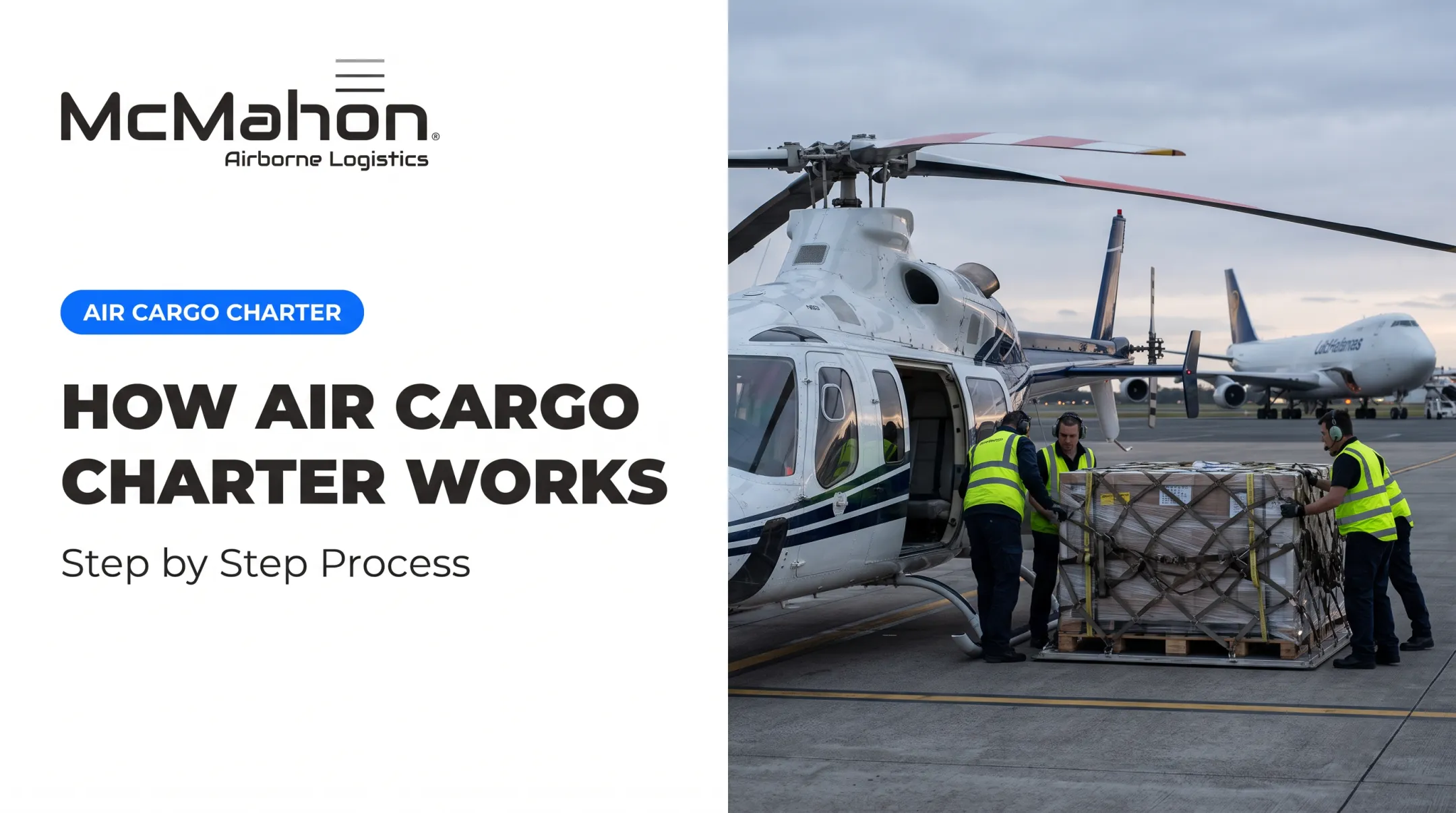
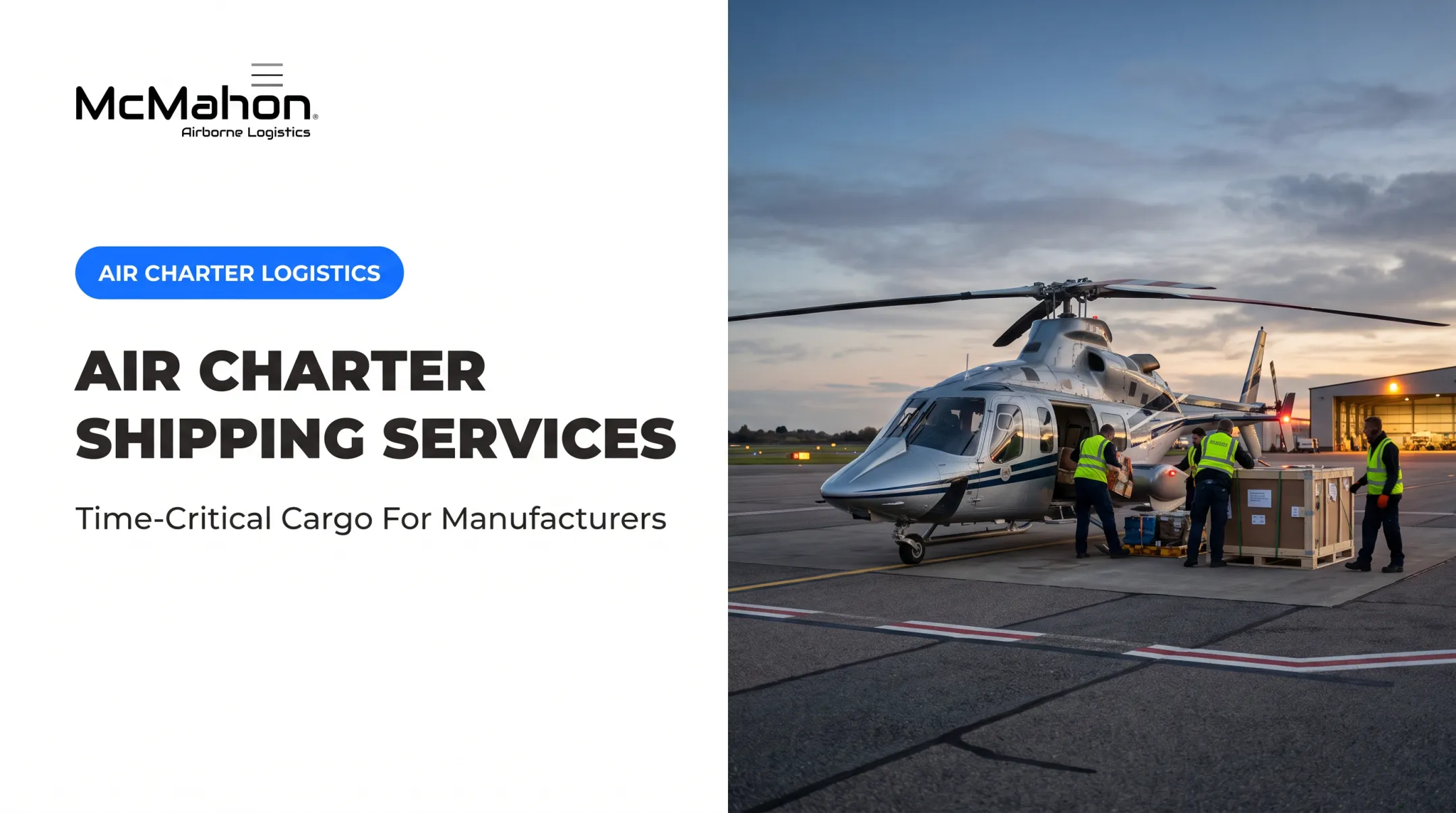
Charter isn't limited to fixed-wing aircraft. Helicopters fall under the same umbrella, and they're uniquely suited for locations without airport infrastructure at all — think manufacturing plants, remote job sites, or energy facilities.
According to Boeing's World Air Cargo Forecast, nonscheduled cargo operations in North America totaled 72,102 million cargo tonne-kilometers in 2023, showing how much freight already moves outside fixed schedules.
Air Cargo Charter vs. Scheduled Air Freight
| Factor | Scheduled Air Freight | Air Cargo Charter |
|---|---|---|
| Routing | Fixed routes and hubs | Direct, custom routing |
| Cargo space | Shared with other shippers | Dedicated to your shipment |
| Timing | Published timetables | Client-controlled departure |
| Cost | Lower base rates | Premium, but justified by urgency |
Scheduled freight wins on cost when time isn't critical. Charter wins when time is the cost.
How Does Air Cargo Charter Work?
The process moves fast, but it follows a consistent sequence:
- Submit cargo details: weight, dimensions, origin, destination, required delivery time, and any special handling needs
- Select the aircraft: the provider matches your cargo based on size, distance, and destination runway or landing conditions
- Arrange permits and coordination: the provider handles airport slots, customs where applicable, and ground transport on both ends
- Load and fly: cargo is loaded and the aircraft flies direct (or with minimal fuel stops), with real-time monitoring
- Deliver: on arrival, cargo is unloaded and moved to its final destination via coordinated ground transport

According to Air Charter Service, strong carrier relationships can get cargo airborne within roughly an hour of confirmation in urgent cases. That figure is a provider-specific benchmark, not a universal guarantee. Real timelines depend on aircraft availability, permits, and destination requirements.
McMahon Airborne Logistics documents a 15-minute sourcing time for turnkey air charter requests, with real-time tracking available once a shipment is in motion. That speed at the front end matters just as much as the flight itself when a production line is waiting.
Key Benefits of Air Cargo Charter
- Direct point-to-point flights skip hub delays and layovers entirely, with no waiting on connections or missed transfer windows
- You set the schedule, departure airport, and route so the aircraft works around your deadline
- Charter aircraft, including helicopters, can use smaller airports, unpaved strips, or bypass airports entirely
- Aircraft matched to your cargo, from small turboprops to large freighters, so you're not paying for wasted space or scrambling for capacity you don't have
- Dedicated aircraft with no co-mingled freight cut damage, loss, and delay from multiple transfer points McMahon's helicopter fleet, for instance, doesn't require a runway for takeoff or landing. Airport size only matters if specific ground-handling or fuel services are needed. McMahon Airborne Logistics takes a turnkey approach to all of this: air and ground transportation quoted together, with 24/7 availability for time-critical shipments across the U.S. That single point of contact matters when you don't have time to coordinate three vendors separately.

When Should You Use Air Cargo Charter?
Charter earns its cost in specific, high-stakes situations:
- Production line down or AOG (Aircraft on Ground) situations, where every hour of delay costs far more than the charter itself
- Oversized, heavy, or hazardous cargo that simply won't fit standard commercial freight holds
- Deliveries to remote sites — mining operations, energy facilities, construction sites — with no scheduled air service or usable road access
Real-world cases show the pattern clearly. Chapman Freeborn arranged a Boeing 747 freighter to move more than 5 tonnes of time-critical car parts from Germany to the United States to keep a production line running, and providers like McMahon Airborne Logistics handle similar scenarios closer to home using a dedicated helicopter fleet for sites without airport access.
Automotive manufacturing is a classic charter use case for exactly this reason. Tier suppliers operate on just-in-time schedules, and a single missing part can idle an entire assembly line. Energy and utility companies face similar pressure when equipment failures threaten to halt operations with no scheduled freight option nearby — a gap that's driven demand for post-storm utility support and other on-demand charter response.
Types of Aircraft Used in Air Cargo Charter
Not every shipment needs the same aircraft. Providers match the plane to the cargo:
- Small turboprops (Pilatus PC-12, Cessna Caravan) — ideal for short-to-medium range trips and unimproved airstrips. The PC-12 carries up to 2,336 lbs and reaches roughly 1,568 nautical miles depending on payload.
- Midsize jets (Falcon 20, DC-9) — faster medium-range delivery for palletized freight. A DC-9 can carry up to 14 standard 48-inch cubed containers at a 500 MPH cruise speed.
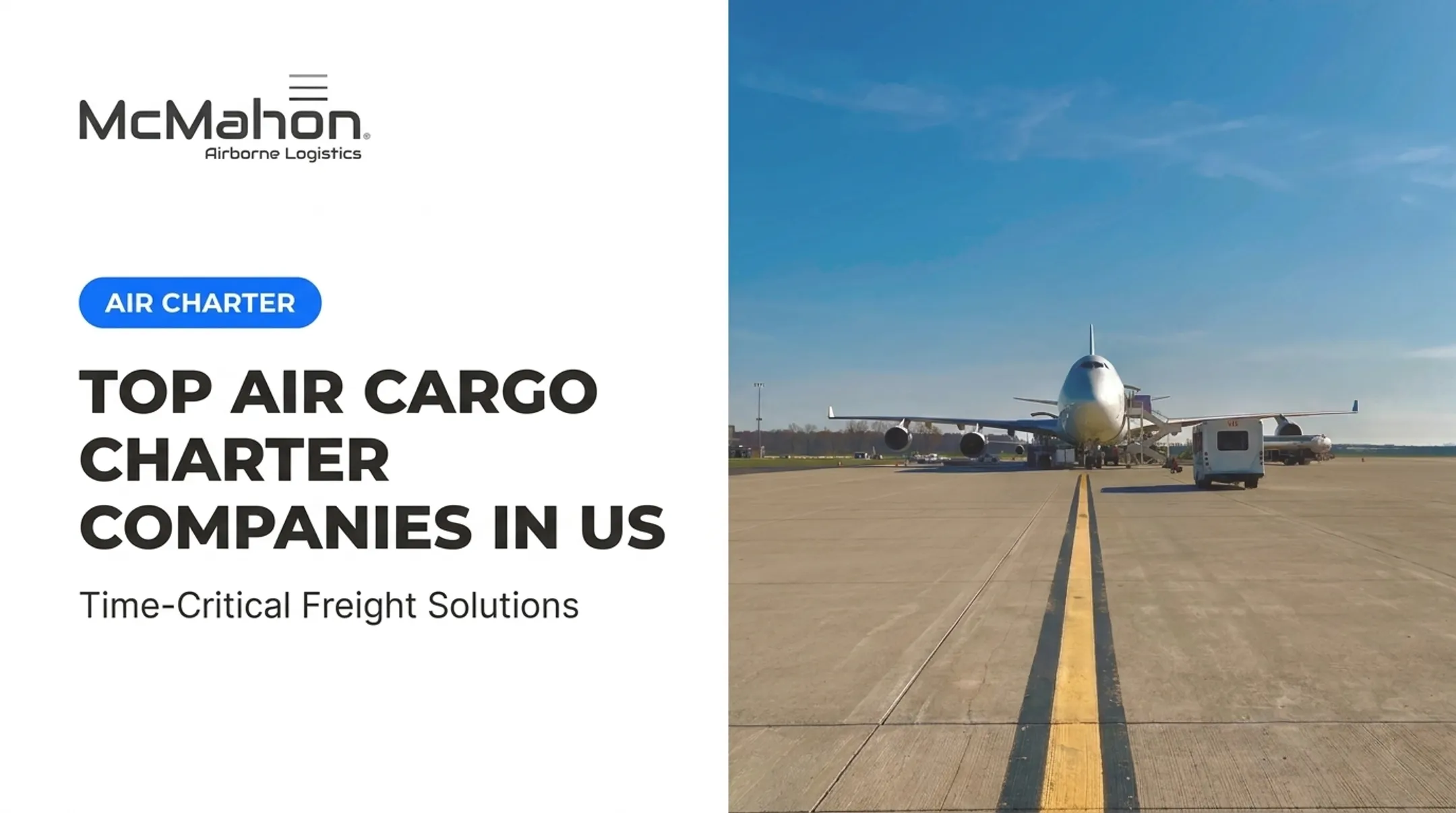
- Large freighters (Boeing 747-400F) — heavy-lift capability for high-volume, long-haul shipments, with revenue payloads exceeding 247,000 lbs.
- Helicopters — reach locations without airport access and reconfigure quickly between cargo and passenger roles.

This last category is where McMahon's fleet stands apart. Dedicated Bell 430 twin-engine helicopters stay on standby for short- and medium-range premium freight, bypassing airport handling and extra transfers. For a plant-to-plant shipment with no runway at the destination, helicopter charter is often the only practical option.
Choosing the Right Air Cargo Charter Provider
Not every charter provider offers the same level of support. Before committing, check for:
- 24/7 quoting and coordination, so an urgent shipment at 2 a.m. doesn't wait for business hours
- Integrated door-to-door service, with ground pickup and delivery bundled into the same quote as the flight
- Fleet ownership vs. broker-only status: asset-based providers control more of the process directly
- Geographic coverage matching your actual shipping needs
Asset-based providers bring a real advantage here. McMahon Airborne Logistics, operating since 1980, combines an owned helicopter fleet, an in-house ground carrier, and brokerage access to FAA-licensed Part 121 and Part 135 jet operators, all under one point of contact.
That means one call sources the aircraft, arranges the ground legs, and tracks the shipment, instead of juggling three separate vendors while your production line sits idle.
Frequently Asked Questions
What does charter mean in simple terms?
Chartering means renting an entire aircraft exclusively for your shipment. You control the routing and schedule, and you are not sharing space with other shippers.
What's the difference between a regular flight and a charter flight?
Regular flights run on fixed schedules and routes, with cargo space shared among multiple shippers. Charter flights are on-demand, dedicated to one customer, and routed however that customer needs.
Which airlines are charter airlines?
There isn’t a fixed list of “charter airlines.” Cargo charter capacity comes from specialized carriers and brokers who source aircraft on demand. That model is separate from major scheduled passenger or freighter airlines that fly set routes and timetables.
Who pays for charter flights?
The shipper or company chartering the aircraft pays the full cost of the flight. That exclusive use is the tradeoff for on-demand routing and schedule control.
Can anyone fly on a cargo plane?
Generally no. Cargo planes are restricted to authorized personnel and freight under FAA rules. Some charter arrangements do allow a courier or company representative to accompany especially time-critical shipments, but this depends on the operator and aircraft category.