
Many businesses struggle with the same pain points repeatedly: missed delivery deadlines, aircraft-on-ground (AOG) events that ground revenue-generating equipment, production downtime that bleeds cash by the hour, and last-minute passenger moves that can't wait for the next available seat.
This article breaks down how air charter express works, what drives the cost, and how to choose a provider that won't leave you stranded when timing matters most.
Key Takeaways
- Move urgent cargo or passengers on demand, often within hours or even minutes of booking
- Price depends on aircraft, distance, and urgency; helicopters win on short runs without airport access
- 24/7 support, owned aircraft, and door-to-door coordination cut delay risk
- McMahon Airborne Logistics unites helicopter, fixed-wing brokerage, and ground logistics in one move
What Is Air Freight Charter Express and How Does It Work
Air charter express is on-demand, non-scheduled air transport for urgent cargo or passengers. The FAA classifies this under Part 135, covering unscheduled operations where departure time, location, and destination are negotiated directly with the customer. That differs from Part 121 scheduled airline service, where routes and times are set in advance.
The typical process looks like this:
- Quote request — Customer describes shipment specs and required delivery deadline (the "protect time")
- Aircraft selection — Provider matches payload, range, and site access to the right aircraft
- Loading and dispatch — Cargo is loaded or passengers board, then the aircraft departs
- Time-stamped tracking — Real-time updates confirm status through delivery

Two main charter types cover most needs:
- Dedicated cargo charters for freight
- Passenger charters for ad hoc single trips or contract group moves
Helicopters Fill a Specific Gap
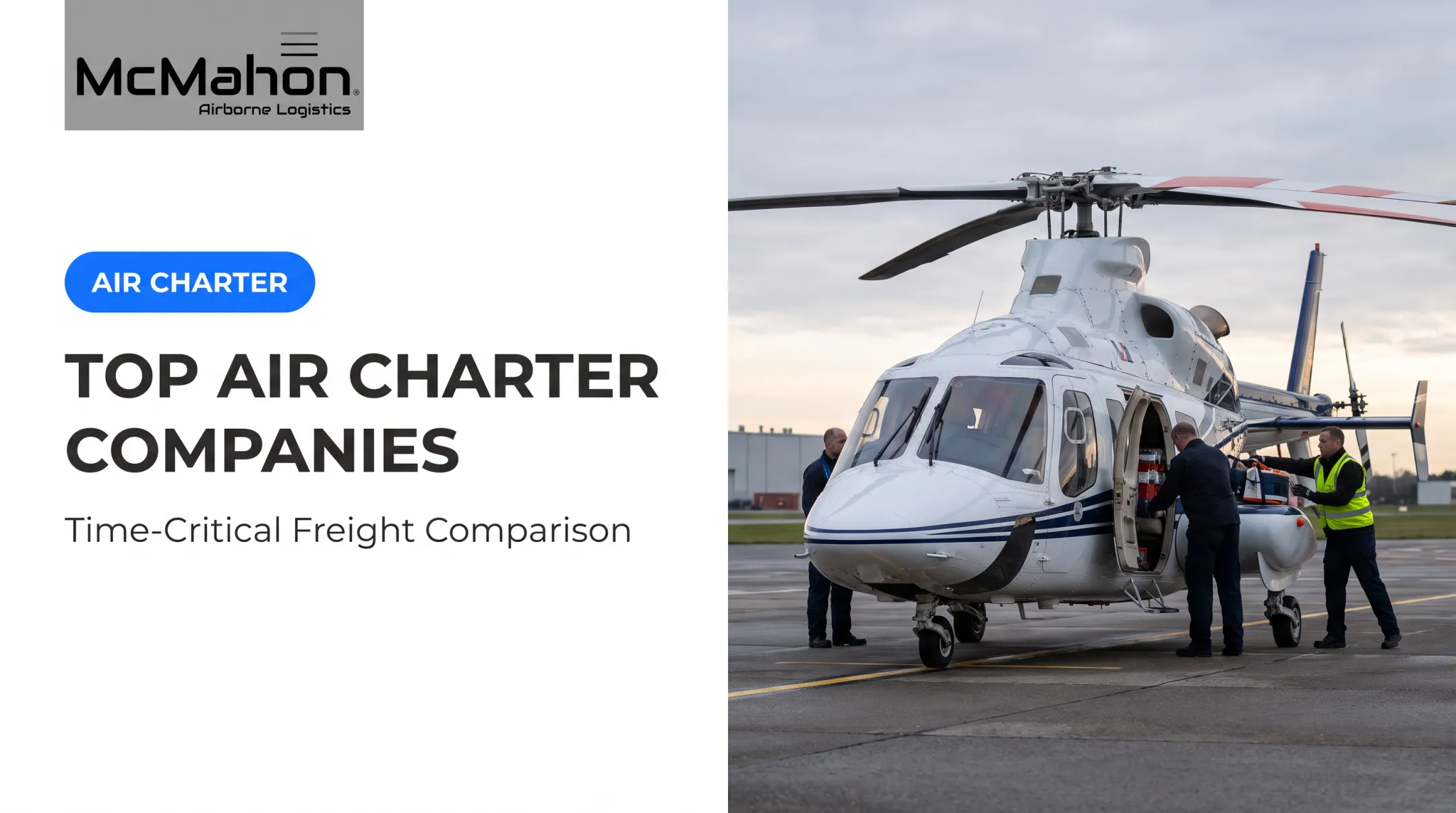
Helicopters matter here because they don't need a runway. For short-to-medium runs where the destination lacks convenient airport access, such as a manufacturing plant or remote job site, a helicopter can land close to the actual point of need. That cuts out the ground transfer leg entirely.
At McMahon Airborne Logistics, this process is fast by design. For known customer locations, the aviation team typically provides timing and cost within about five minutes over the phone. Once authorized, a Bell 430 helicopter can be airborne in 10-15 minutes during business hours, or 45-60 minutes after hours.
Industries and Situations That Rely on Air Freight Charter Express
Urgency shows up across a surprisingly wide range of sectors, and the reasons are almost always financial.
AOG events in aviation are the clearest example. When an aircraft is grounded waiting on a part, it's not flying, and it's not earning. Costs vary by aircraft type, route, and airline, but every grounded hour carries a real price. Speed of parts delivery directly affects that exposure.
Automotive and manufacturing operations face similar math. A Siemens 2024 industry analysis found that unplanned downtime now costs automotive manufacturers roughly $2.3 million per hour, more than double the 2019 estimate. That scale is why a missing part can justify an air charter when the line is truly down.

Other common users include:
- Healthcare and pharma — temperature-sensitive shipments with tight delivery windows
- Event logistics and sports teams — passenger charters for schedules that commercial flights can't accommodate
- Utilities and energy — post-storm crew transport to inspect and restore damaged infrastructure
McMahon Airborne Logistics serves automotive OEMs, tier suppliers, and utility companies as core customers, with helicopter cargo moving plant-to-plant and often skipping airports entirely.
What Determines the Cost of Chartering a Plane or Cargo Aircraft
Charter pricing isn't a flat rate. It moves based on several factors layered together.
For passenger charters, aircraft class drives most of the variation. Q2 2024 data from JetASAP's industry activity report, based on more than 20,000 operator quotes, showed these hourly averages:
| Aircraft Category | Average Hourly Rate |
|---|---|
| Turboprop | $4,467 |
| Light jet | $7,044 |
| Midsize jet | $8,425 |

These are 2024 planning benchmarks, not current quotes, and they reflect occupied passenger flight hours only.
For cargo charters, the drivers shift:
- Aircraft size required for the shipment weight and dimensions
- One-way versus round-trip positioning costs
- Ground handling fees at origin and destination
- Distance and fuel requirements
According to the Air Charter Journal's cargo pricing overview, a short-haul cargo flight on a smaller aircraft can start around $15,000, while a long-haul move on a large freighter can exceed $500,000. That spread is wide, and the final figure depends entirely on the mission.
Availability matters too. 24/7 readiness and shorter lead times add crew positioning costs that scheduled operators typically avoid.
Bundled Quotes Reduce Guesswork
Piecing together separate air and ground vendors adds risk: extra handoffs, extra invoices, extra chances for delay. A door-to-door quote that bundles the flight with ground pickup and delivery on both ends is far more predictable.
McMahon Airborne Logistics structures its fixed-wing cargo charters as turnkey programs, with ground transport included at both ends through its own Southeast Michigan assets or partner carriers nationwide.
Choosing the Right Air Freight Charter Express Provider
Not every charter company operates the same way, and that difference matters when your deadline is tight.
Key criteria to evaluate:
- Fleet ownership vs. broker-only — Does the provider own aircraft, or do they exclusively arrange third-party capacity?
- Response time — Can they quote and dispatch within minutes, not hours?
- Geographic coverage — Do they serve your specific routes reliably?
- Tracking visibility — Can you see shipment status in real time?
An asset-based carrier, one that owns its own aircraft and ground vehicles, offers more control than a pure broker. There's no third party to coordinate with when timing gets tight, and no dependency on someone else's aircraft availability.
Proprietary tracking software strengthens that control. McMahon's platform, available on web and iOS, lets you follow shipments in real time across helicopter, fixed-wing, and van segments. You get milestone updates, map-based tracking, and direct chat with dispatch.

McMahon Airborne Logistics is a 45-year asset-based air and ground carrier with a dedicated Bell 430 helicopter fleet, in-house maintenance, and proprietary logistics software. Everything comes under one quote across the U.S. and Canada.
Helicopters vs. Fixed-Wing: Picking the Right Aircraft for Express Delivery
The right aircraft depends on the mission: distance, payload, and how close you can land to the dock.
Helicopters make sense when:
- The route is short-to-medium range
- The destination lacks convenient airport access
- Facility-to-facility delivery beats airport handling and ground transfers
McMahon's Bell 430s cruise around 160 mph and carry roughly 1,200-1,400 pounds with full fuel. On comparable routes, that cargo moves 2.2 times faster than ground vehicles traveling at 70 mph, largely because there is no traffic, no terminal, and no transfer delay.

When range or payload outgrows rotorcraft limits, fixed-wing is the better tool.
Fixed-wing aircraft make sense when:
- The distance is long-range or cross-country
- The cargo is heavier or bulkier than a helicopter can carry
- The shipment needs higher volume or multi-piece capacity in one lift
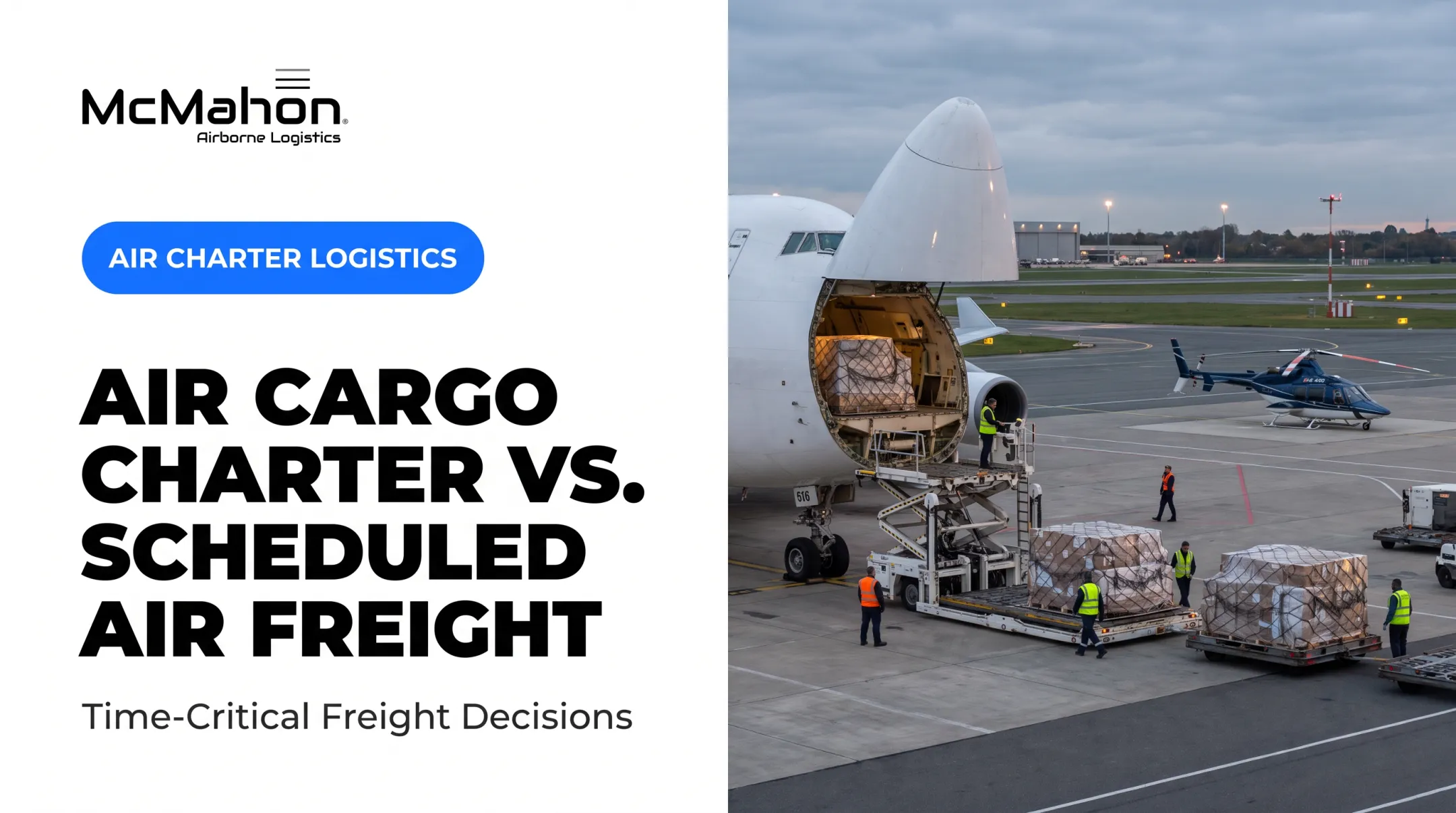
A brokered Boeing 737, for example, can carry up to 30,000 pounds across 36 standard containers at roughly 500 mph—far beyond helicopter capacity.
The best setups combine both. McMahon brokers the long-haul fixed-wing segment through FAA-licensed Part 121/135 partners, then uses its own helicopter for last-mile delivery when the final leg is the time risk. That mix keeps the protect time intact without forcing every mile onto one aircraft type.
Frequently Asked Questions
How much does a 2-hour private flight cost?
Cost depends on aircraft type and route. Using 2024 industry benchmarks, about two flight hours run roughly $8,900 for a turboprop up to nearly $17,000 for a midsize jet. Request a current quote for exact pricing.
How much does it cost to charter a cargo plane?
Cargo charter costs depend on aircraft size, distance, and urgency. Short-haul flights on smaller aircraft can start around $15,000, while long-haul moves on large freighters can exceed $500,000. Request a custom quote for your shipment.
How quickly can an air charter express shipment be arranged?
Many providers offer 24/7 quoting with standby aircraft ready to move. McMahon Airborne Logistics typically quotes known locations within five minutes and can have a helicopter airborne in 10–15 minutes during business hours.
Can air charter express reach locations without a nearby airport?
Yes. Helicopters can land at facilities, job sites, and other non-airport locations, cutting out the ground transfer leg entirely. This makes airports optional in most short- and medium-range scenarios.
What industries most commonly use air charter express services?
Aerospace AOG support, automotive manufacturing, healthcare and pharma, and event or utility logistics rely heavily on air charter express. Where downtime or delay carries a high cost, speed becomes essential.
Is it cheaper to use one provider for both air and ground transport?
Bundled door-to-door quotes tend to be more cost-predictable than coordinating separate air and ground vendors. One provider, one quote, and fewer handoffs typically means fewer delays and surprise fees.