
For shippers, manufacturers, and logistics managers, delays aren't just inconvenient. A stalled production line or a missed installation window can cost more in a single day than the charter flight itself. Yet most people describe charter as "just renting a plane," when the real process involves quoting, aircraft sourcing, routing, permits, and ground coordination on both ends.
This article walks through exactly how that process works, what drives cost and timing, and when charter (including helicopter charter) actually makes sense.
TL;DR
- Air cargo charter dedicates an aircraft to your freight, matched to size, urgency, and destination
- End-to-end flow: request, quote, aircraft and routing selection, documentation, loading, flight, delivery
- Weight, dimensions, distance, and airport access all affect cost and timing
- Helicopters bypass airport limitations entirely for short- and medium-range freight
- McMahon Airborne Logistics combines helicopter and fixed-wing charter with door-to-door ground coordination in one quote
What Is the Air Cargo Charter Process?
Air cargo charter is the end-to-end coordination of booking, routing, and flying a dedicated aircraft for one shipper's cargo, on that shipper's timeline. The outcome is guaranteed capacity, direct routing, and a known arrival window instead of competing for space on someone else's schedule.
This differs from two common alternatives:
- Scheduled air freight shares capacity across multiple shippers and runs on fixed timetables, regardless of your urgency.
- Ground expedite moves freight by road, which works for shorter distances but can't compete with air over long stretches.
Charter exists for the gap between those two: freight that's too urgent for scheduled service and too far for a truck to close the gap in time.
Why Businesses Use Air Cargo Charter
Businesses turn to charter when the cost of delay outweighs the cost of the flight. That's the whole calculation. A halted production line, a missed contractual deadline, or a stalled installation crew often costs far more per hour than the aircraft does.
Standard freight can't flex around three things:
- Fixed schedules that don't move for your emergency
- Size and weight limits on shared aircraft
- Airport-dependent routing that may not reach your actual site
Those limits are why charter shows up so often in automotive, energy, and healthcare — industries where a single missed part can freeze operations.
One documented case: a full-charter Airbus A310 moved automotive parts door-to-door in 24 hours, despite bad weather complicating the operation (Air Cargo News).
Charter isn't a regulatory requirement. It's an operational choice made when time-criticality justifies the premium.
How the Air Cargo Charter Process Works (Step-by-Step)
The process moves from identifying urgency to final delivery, coordinated by a broker or provider who matches an aircraft to your cargo's specs. Matching typically hinges on:
- Weight and dimensions of the shipment
- Origin and destination, including whether the destination has airport access
- "Need ready" and "protect" time (how much runway you have before things go wrong)
- Special handling: hazmat classification, temperature control, oversized loads
From there, the provider sources the aircraft, gets routing approved, oversees loading, and executes the flight with minimal handling in between. Behind the scenes, they also coordinate airport slots, customs paperwork, ground handling, and crew/fuel logistics: the work most shippers never see, and the work that decides whether the "guaranteed" window actually holds.

Step 1: Submit Shipment Details and Request a Quote
You provide weight, dimensions, destination, urgency, and any hazmat classification. This is the assessment stage: the more complete your data, the faster the quote. McMahon's team can typically return timing and cost in about five minutes for known customer locations.
Step 2: Aircraft Sourcing and Route Planning
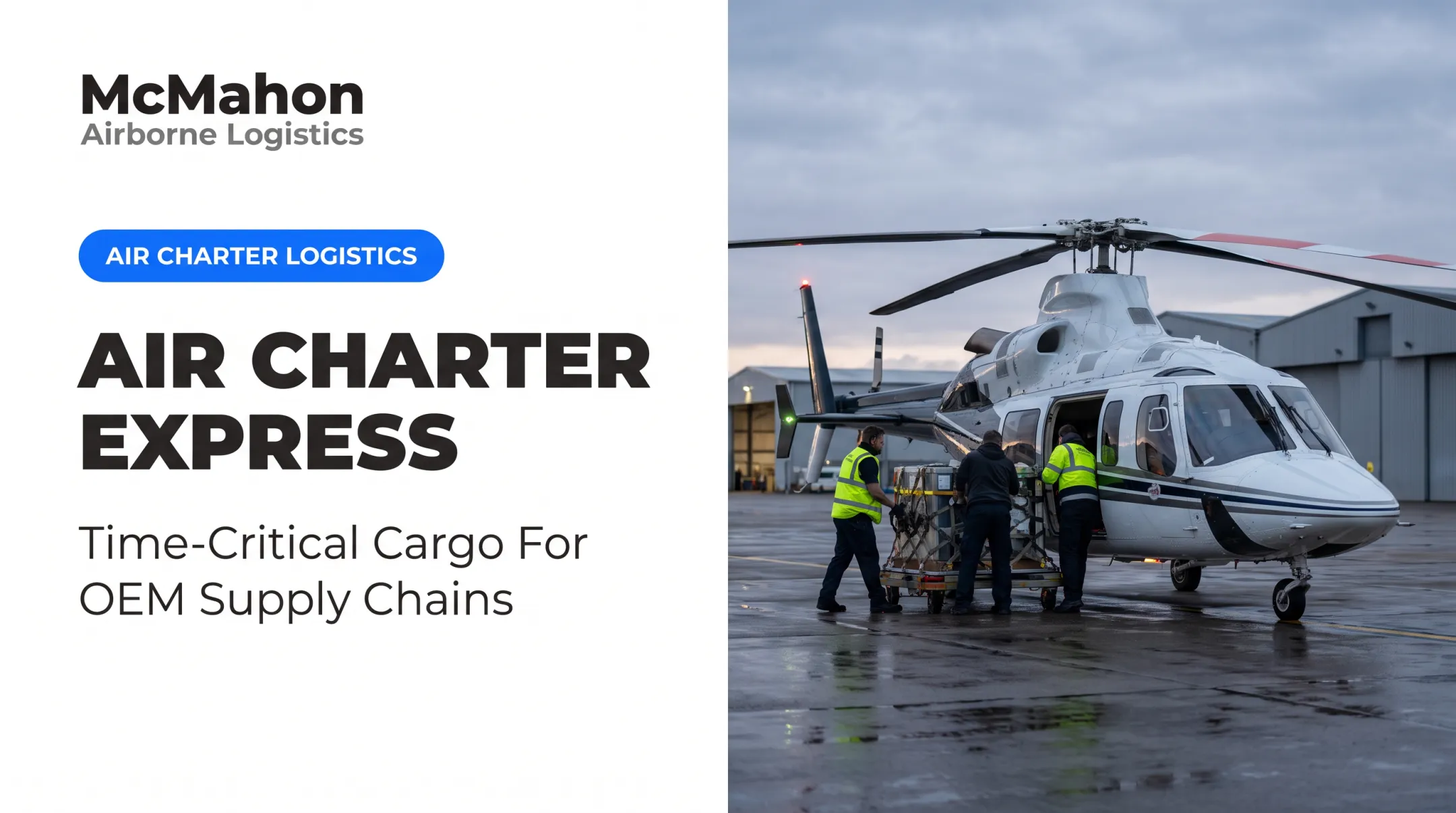
The provider matches your cargo to an available aircraft (helicopter, turboprop, or larger freighter) and plans the most direct route. This is also where airport-optional routing comes into play: a helicopter can fly plant-to-plant, skipping the airport entirely in most cases.
Step 3: Confirm Quote, Documentation, and Scheduling
Once you pick an option, the provider finalizes contracts, air waybills, and any customs or permit documentation, then locks in departure scheduling. For international movements, U.S. Customs and Border Protection requires advance electronic cargo data, so this step needs to start early rather than as an afterthought.
Step 4: Cargo Loading and Ground Coordination
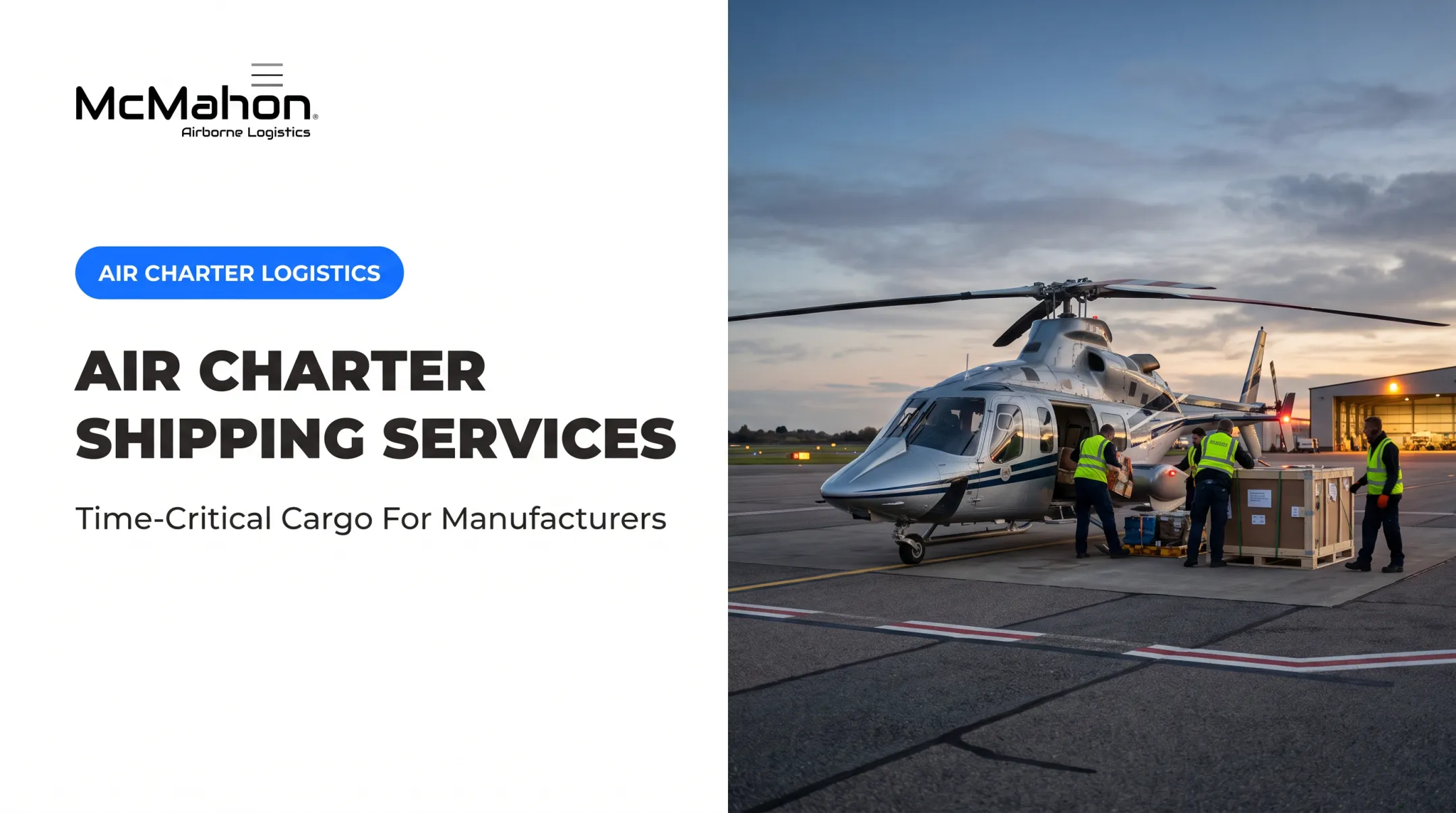
Crews secure and load the cargo while ground teams arrange transportation on both ends. That coordination is what makes charter "door-to-door" rather than just airport-to-airport: someone still has to move the shipment from the tarmac to the loading dock.
Step 5: Flight Execution and Final Delivery
The aircraft flies directly to (or near) the destination. Unloading and last-mile ground delivery follow, often trackable in real time through a provider's tracking portal.

Where Air Cargo Charter Is Applied
Charter typically gets triggered by specific events, not scheduled routines:
- Emergency replacement parts for a stopped production line
- Oversized machinery or project cargo with tight installation deadlines
- Medical or pharmaceutical shipments requiring temperature control
- Missed just-in-time deliveries or natural disaster response
Charter is condition-based. It's called in when a problem hits, not booked as a recurring service like scheduled freight.
One distinct use case: short-to-medium range freight bound for sites without convenient airport access. Dedicated helicopter fleets can land at the facility directly instead of routing through the nearest airport and handing off to a truck.

Key Factors That Affect the Charter Process
Several factors drive charter cost and timing:
- Cargo weight, dimensions, and handling needs: Hazmat or temperature control narrows which aircraft can take the job
- Distance and routing: Tech stops or repositioning flights add time and cost
- Aircraft availability: Peak demand or limited fleet options mean longer lead time
- Destination accessibility: Sites without airport access may need ground transport or helicopter delivery
- Urgency and timing of the request: Last-minute or off-hours departures typically cost more
Common Issues and Misconceptions
"Charter only works between major airports." Not true. Helicopter operators can reach remote or regional sites directly — no runway required. Airport size only matters if you need ground handling or fuel services along the way.
"It's just booking a bigger plane." Aircraft selection, permits, and ground coordination all require real expertise. Getting the wrong aircraft type or missing a permit window can defeat the purpose of chartering.
"The flight price is the total cost comparison." It isn't. The real comparison is charter cost versus the cost of delay: downtime, penalties, missed installs. A charter that looks expensive on paper often looks cheap next to a stalled plant.
"Guaranteed delivery windows are guaranteed." They still depend on weather, permits, and ground handling being coordinated correctly. FAA data shows weather caused 74.26% of system-impacting delays over 15 minutes between June 2017 and May 2023 (FAA). Charter is flexible, not weather-proof.

When Air Cargo Charter May Not Be the Right Choice
Charter isn't always the answer. Consider standard freight when:
- The shipment is routine and non-urgent — scheduled freight is more cost-effective
- Budget constraints mean the delay cost genuinely doesn't outweigh charter pricing
- Large, non-urgent bulk cargo is a better fit for ocean or ground freight
Short-haul and routine freight usually belong on the ground. The Bureau of Transportation Statistics reports that 74.1% of freight weight moved less than 250 miles in 2024, with trucks carrying the largest value share under 2,000 miles (BTS). If your shipment fits that profile, air charter is likely overkill.
Watch for the habit trap, too: when a business defaults to charter out of routine rather than genuine time-criticality, it pays a premium it doesn't need.
Conclusion
Air cargo charter is a structured process that matches an urgent shipment to a dedicated aircraft, route, and delivery plan. Understanding each step, from quote request to final ground delivery, helps you set realistic expectations on cost and timing before a crisis hits.
Pairing air charter with integrated ground coordination keeps time-critical shipments on schedule from origin to final destination. That is the model McMahon Airborne Logistics runs on: helicopter and fixed-wing charter options quoted together with door-to-door delivery, so you are not managing separate vendors while your production line waits.
Frequently Asked Questions
How does a charter flight work?
A shipper submits cargo details, a provider sources a suitable aircraft, and the flight is scheduled and routed directly to the destination based on the shipment's timeline. Ground coordination on both ends completes the door-to-door movement.
What are the three types of charters?
Full charter reserves the entire aircraft for your shipment. Part charter shares space with other freight on the same charter flight. Helicopter charter handles short-range, airport-optional freight, landing directly at a facility when needed.
Who is the charterer in air cargo?
A charterer is the shipper or business that contracts aircraft capacity for a specific cargo move, instead of booking space on a shared, scheduled freighter.
What are the steps involved in the cargo shipment process?
The flow runs: request and quote, aircraft and route selection, documentation, loading, flight execution, and final ground delivery. Each stage locks in before the next one starts.
How fast can an air cargo charter be arranged?
Simple domestic charters can sometimes be arranged within hours when the aircraft, route, and paperwork are ready. Complex international routes may take 24-72 hours for permits and planning.
Is air cargo charter more expensive than standard freight?
Yes, upfront. Charter often pays for itself when you factor in production downtime, missed deadlines, or contractual penalties that can exceed the flight price.