
Here's the catch: pricing depends on aircraft type, distance, cargo type, and how fast you need it airborne. Anyone quoting you a flat "average price" is oversimplifying a spot-market service. This guide breaks down real cost ranges, what drives them, and how to budget for a U.S. charter shipment without getting blindsided by hidden fees.
TL;DR
- $3,000–$20,000 covers most light/regional charters; heavy long-haul freighter missions can exceed $800,000
- Aircraft size, distance, positioning fees, cargo type, and lead time drive most of the quote
- Short-haul runs, light cargo, and flexible scheduling produce the lowest rates
- Long-haul routes, oversized freight, and same-day emergency requests cost the most
- Charter pays off when downtime cost exceeds the shipment cost, not as a blanket swap for scheduled freight
How Much Does an Air Cargo Charter Cost? (Pricing Overview)
There's no fixed rate card for air cargo charter. It's a spot-market service — every quote gets built mission by mission around aircraft availability, route, and timing. Published hourly benchmarks exist, but treat them as planning bands, not guaranteed published U.S. rates.
Common mistakes shippers make:
- Assuming a flat per-mile rate exists (it doesn't)
- Forgetting positioning/repositioning fees entirely
- Underestimating fuel surcharges and handling costs as "extras" rather than core line items
Knowing those gaps, use the bands below for planning—not as a final invoice.
Typical Cost Ranges (U.S.-Focused)
| Charter tier | Aircraft type | Typical cost |
|---|---|---|
| Light/Regional | Turboprop, helicopter | $3,000–$20,000 |
| Mid-Range | Narrowbody freighter | $20,000–$100,000 |
| Heavy/Long-Haul | Widebody freighter | $150,000–$800,000+ |

These figures generally include aircraft, crew, fuel, and standard handling. They typically exclude positioning flights, permits, special handling, and ground transportation. Those costs can add up fast if nobody flags them upfront.
Light/Regional Range Covers aircraft-and-crew service for short legs — think AOG parts, time-critical documents, or helicopter access to sites without a runway. Best for businesses needing rapid regional delivery, including locations airports simply can't reach.
Mid-Range Full or part-charter narrowbody freighter service for palletized cargo. This tier fits regional manufacturing, automotive, and e-commerce shippers moving meaningful volume without needing a widebody.
Heavy/Long-Haul Range Widebody freighter capacity for large-volume, coast-to-coast, or international freight. Industrial equipment movers and humanitarian relief operations typically book in this tier.
Key Factors That Affect the Cost of Air Cargo Charter
Pricing hinges on aircraft, route, cargo specifics, and timing. Distance alone doesn't tell the story.
Aircraft Type & Size
Helicopters, turboprops, narrowbody, and widebody freighters carry very different hourly rates and capacity. A Boeing 737 charter, for instance, handles up to 36 standard 48-inch containers and 30,000 lbs. at a 500 mph cruise, overkill for a 200-lb emergency part. Matching aircraft size to your actual shipment avoids paying for capacity you'll never use.
Distance & Route Complexity
Longer and international routes add fuel burn, crew hours, and permit requirements. A domestic point-to-point run costs less than a multi-stop routing with layovers baked in.
Positioning (Ferry) Fees
If the nearest available aircraft isn't sitting at your departure point, you pay for the empty flight to get it there, and often the return leg too. This is one of the most commonly overlooked line items in a quote.
Cargo Type & Handling Requirements
Expect premiums for:
- Dangerous goods requiring permits and clearances
- Temperature-controlled pharmaceutical shipments needing thermal equipment
- Oversized or outsized freight requiring special loading
- High-value cargo needing added security
Urgency & Booking Lead Time
Same-day or emergency charters cost more than shipments booked 7–14 days out. Operators price in the scramble to source and position aircraft on short notice.
Access to Non-Standard Locations
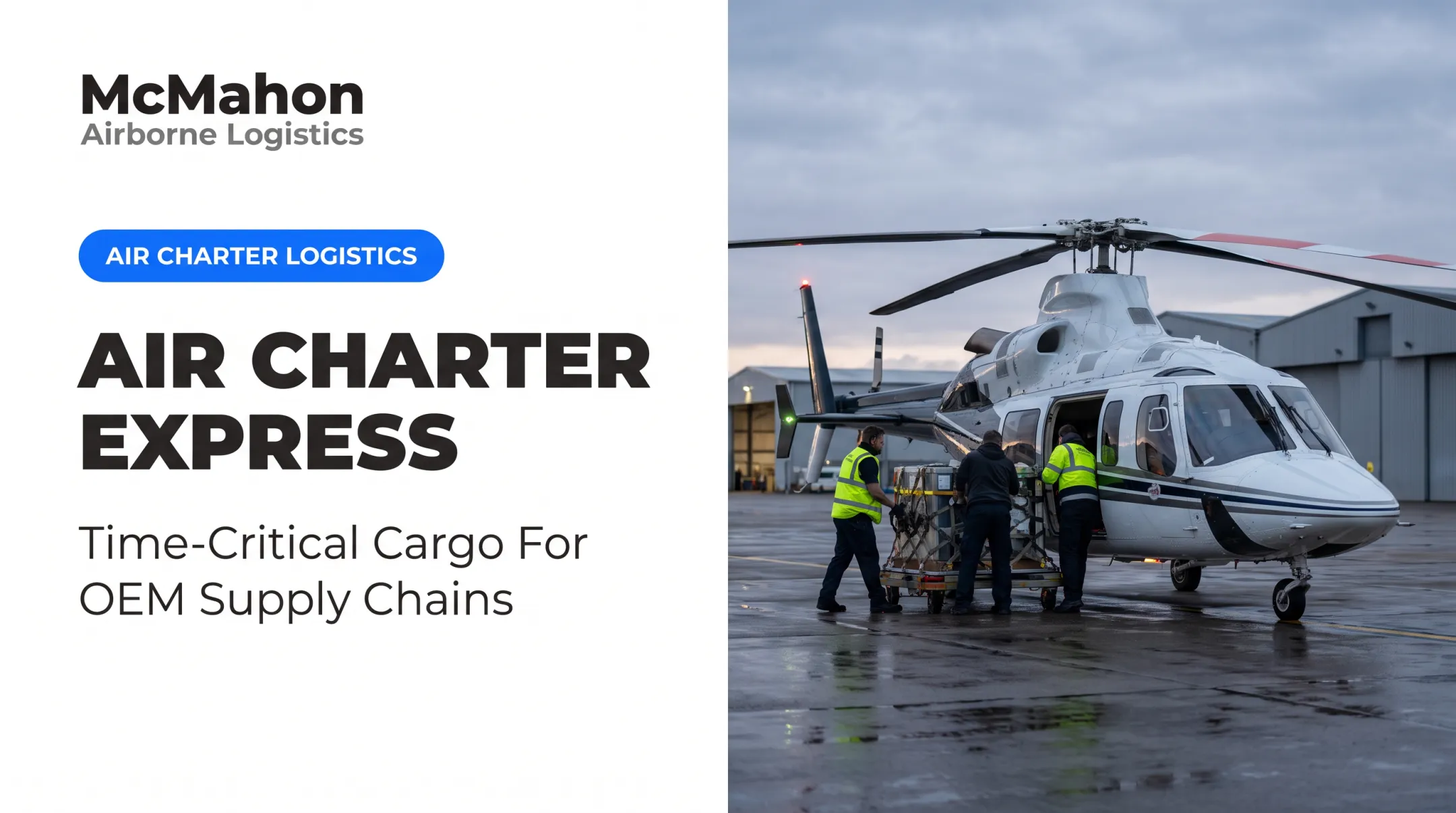
Fixed-wing freighters need a runway. Helicopters don't. That distinction matters when your facility sits outside airport reach. Manufacturing plants and energy sites in rural areas run into this often. McMahon Airborne Logistics operates a dedicated Bell 430 helicopter fleet for these moves, landing at facilities jets can't reach without a runway.

Cost Breakdown of an Air Cargo Charter
The aircraft fee is only one line on the invoice. Total landed cost usually includes:
| Component | Timing | What it covers |
|---|---|---|
| Aircraft/block-hour fee | One-time | Aircraft, crew, standard insurance |
| Positioning & repositioning | One-time | Bringing the aircraft to you and back |
| Fuel surcharges | Variable | Fluctuates with jet fuel pricing |
| Landing, handling & permits | One-time | Airport fees plus docs for special or international cargo |
| Ground transportation | One-time | Often quoted separately unless bundled |

That last line matters more than most shippers expect. A flight-only quote leaves pickup and delivery to you — extra handoffs, time, and cost when speed is the point.
Positioning distance, fuel, and special permits usually move the total most. Ask how each is calculated before you sign.
Providers that bundle air and ground into one door-to-door figure close that gap. McMahon Airborne Logistics quotes integrated air-and-ground moves as a single number so you are not reconciling three invoices under a tight protect time.
Full Charter vs. Part-Charter — What's the Difference?
Full charter reserves the entire aircraft for your shipment. Part-charter shares space with other shippers' freight.
| Factor | Full Charter | Part-Charter |
|---|---|---|
| Cost | Pay for the whole aircraft, regardless of load | Pay only for space/weight used |
| Control | Exact departure time and routing | Dependent on consolidation schedule |
| Best fit | Time-critical, oversized, or sensitive cargo | Flexible timelines, cargo under ~60% of capacity |

Part-charter can cut costs, but the savings depend on route, load share, and whether the aircraft would otherwise fly empty.
Full charter makes sense when the schedule can't bend — an AOG part or a stalled production line rarely tolerates a consolidation window.
How to Estimate the Right Budget for Your Air Cargo Charter
Build your budget around mission requirements, not the lowest quote on the table.
Factors to weigh before requesting quotes:
- Actual cargo weight and dimensions: Does it need special handling equipment?
- Real urgency: Is this same-day, or can it flex a few days for better pricing?
- Destination access: Does the site have airport access, or does it need a helicopter/ground combination?
- Ground coordination: Does pickup and delivery need to move with the flight itself?
Justifying the premium: A 2024 Siemens survey found automotive manufacturers now lose an average of $2.3 million per unproductive hour (double the 2019 figure). Even top-end SME downtime runs around $150,000 per hour. Stack that hourly loss against a full charter quote—not standard freight rates—and charter is often the lower-cost choice.
What Most Shippers Miss About Air Cargo Charter Costs
Most charter cost overruns come from a few avoidable habits—not from the base rate itself.
- Headline hourly rates ignore positioning and fuel surcharges that show up later on the invoice
- Oversized aircraft booked "just in case" burn budget on empty capacity—a Boeing 737's 30,000-lb payload is wasted on a 500-lb shipment
- Part-charter and empty-leg options go unasked, leaving real discount dollars on the table
- Separate air and ground quotes create two handoffs instead of one coordinated door-to-door number—extra coordination time exactly when speed matters most
Conclusion
Air cargo charter costs swing on aircraft type, distance, urgency, and cargo specifics. There's no single "market rate" to quote you. Understanding the full cost breakdown, not just the base charter fee, is what keeps budgets accurate and surprises off the invoice.
Providers offering integrated air-and-ground quoting, like McMahon Airborne Logistics, simplify this with one all-in cost for time-critical shipments across the U.S. That can mean a Bell 430 helicopter reaching a plant with no runway, or a brokered jet covering a coast-to-coast run.
Frequently Asked Questions
How much does it cost to send cargo by air?
Scheduled air freight is typically priced per kilogram. Dedicated charter is priced per mission based on aircraft, route, and urgency, so the two models aren't directly comparable.
Is it cheaper to charter or own a plane?
Chartering avoids the multi-million dollar acquisition, crew, and maintenance costs tied to aircraft ownership. For occasional or variable freight needs, charter is usually the more cost-effective option.
What is included in a typical air cargo charter quote?
Most quotes include the aircraft, crew, fuel, and standard handling. Positioning fees, permits, and special handling requirements are often billed separately.
How far in advance should I book an air cargo charter?
Booking 7–14 days ahead typically secures better pricing. Same-day or emergency requests can carry a significant premium due to aircraft sourcing and positioning costs.
Can I reduce costs by sharing a cargo charter with another shipper?
Yes. Part-charter or consolidated freight can lower costs since you only pay for the space and weight you use. It works best when your timeline has some flexibility.
What's the difference between air cargo charter and expedited ground freight?
Air charter is faster and can reach remote or non-airport U.S. locations via helicopter. Ground expedite often works for shorter distances when urgency is lower.