
This is the decision point manufacturers, aerospace suppliers, and energy companies face constantly: pay more for guaranteed speed, or save money and hope the timeline holds. The choice matters because downtime is expensive. In large automotive plants, an hour of downtime can cost $2.3 million, according to Siemens' 2024 True Cost of Downtime report.
This guide breaks down what separates air cargo charter from scheduled air freight, when each makes sense, and how to decide fast when a decision can't wait.
TL;DR
- Charter: dedicated aircraft, custom routing, and on-demand departure for urgent, oversized, or high-value freight
- Scheduled freight: shared space on fixed airline routes; lower cost, but tied to timetables and major airports
- Main tradeoffs: speed, flexibility, cost, and which cargo each mode handles well
- Decide based on urgency, cargo size, and destination accessibility
- Teams with recurring urgent freight often keep a charter provider on standby beside routine scheduled service
Air Cargo Charter vs Scheduled Air Freight: Quick Comparison
Air Cargo Charter vs. Scheduled Air Freight: Quick Comparison
| Factor | Charter | Scheduled Freight |
|---|---|---|
| Cost | Full aircraft cost, priced per shipment | Shared space, lower per-kg rate |
| Speed | On-demand, often airborne within hours | Fixed timetables, advance booking required |
| Routing | Custom routes, access to regional/remote airports | Limited to major hub-to-hub lanes |
| Handling | Dedicated space for oversized/sensitive cargo | Standard ULD handling, size/weight limits |
| Best for | Urgent, oversized, high-value, remote-destination freight | Routine, predictable, budget-conscious shipments |

On major lanes, scheduled air freight often lands near $3/kg for shipments in the 150–500 kg range — for example, Freightos rate data on China–U.S. routes. Charter pricing is bespoke: aircraft type, distance, and how fast you need wheels up all drive the quote.
No single charter-vs-scheduled multiplier applies across the board. Match the mode to the shipment's urgency, size, and routing needs.
What Is Air Cargo Charter?
Air cargo charter means booking an entire aircraft (or a defined portion of one) for your shipment alone. No shared cargo hold, no waiting for a scheduled slot. You set the pickup time, the route, and the destination airport, or skip the airport entirely.
For time-critical U.S. supply chains in automotive, medical devices, and industrial manufacturing, that flexibility decides whether a plant keeps running or sits idle.
Core benefits:
- Dedicated capacity with no transfer risk between flights
- Custom routing to airports scheduled carriers don't serve
- Reduced handling: your cargo isn't stacked with dozens of other shippers' freight
- Departure timed to your protect window, not an airline's schedule
Full Charter, Part Charter, and Helicopter Charter
Not every charter needs a full jet. Full charter dedicates the entire aircraft to one shipment. Part charter works when your cargo doesn't need the whole plane but still requires guaranteed, dedicated handling.
Then there's a category most shippers overlook: helicopter charter. For short- and medium-range shipments, a helicopter skips the airport requirement altogether.
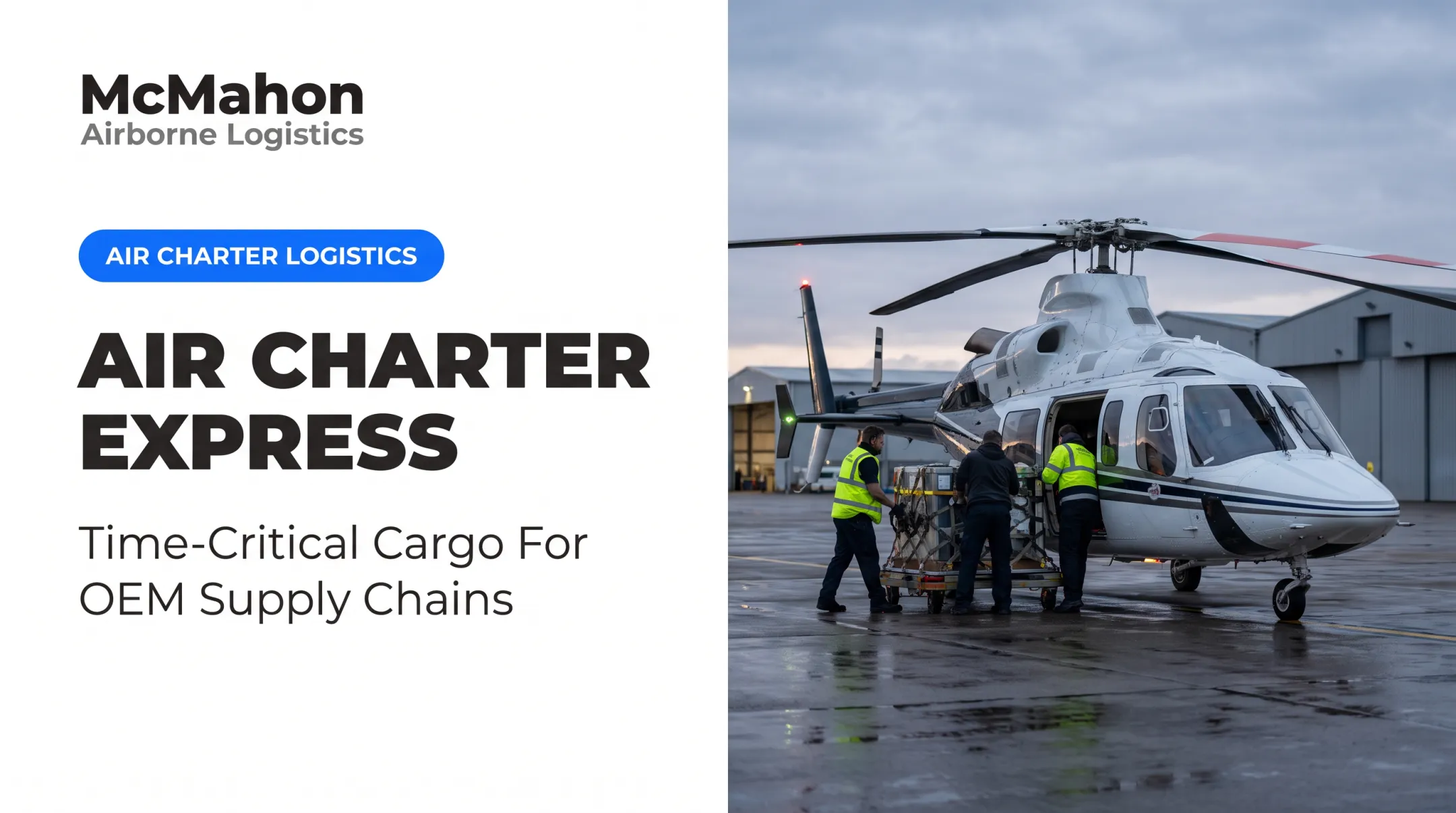
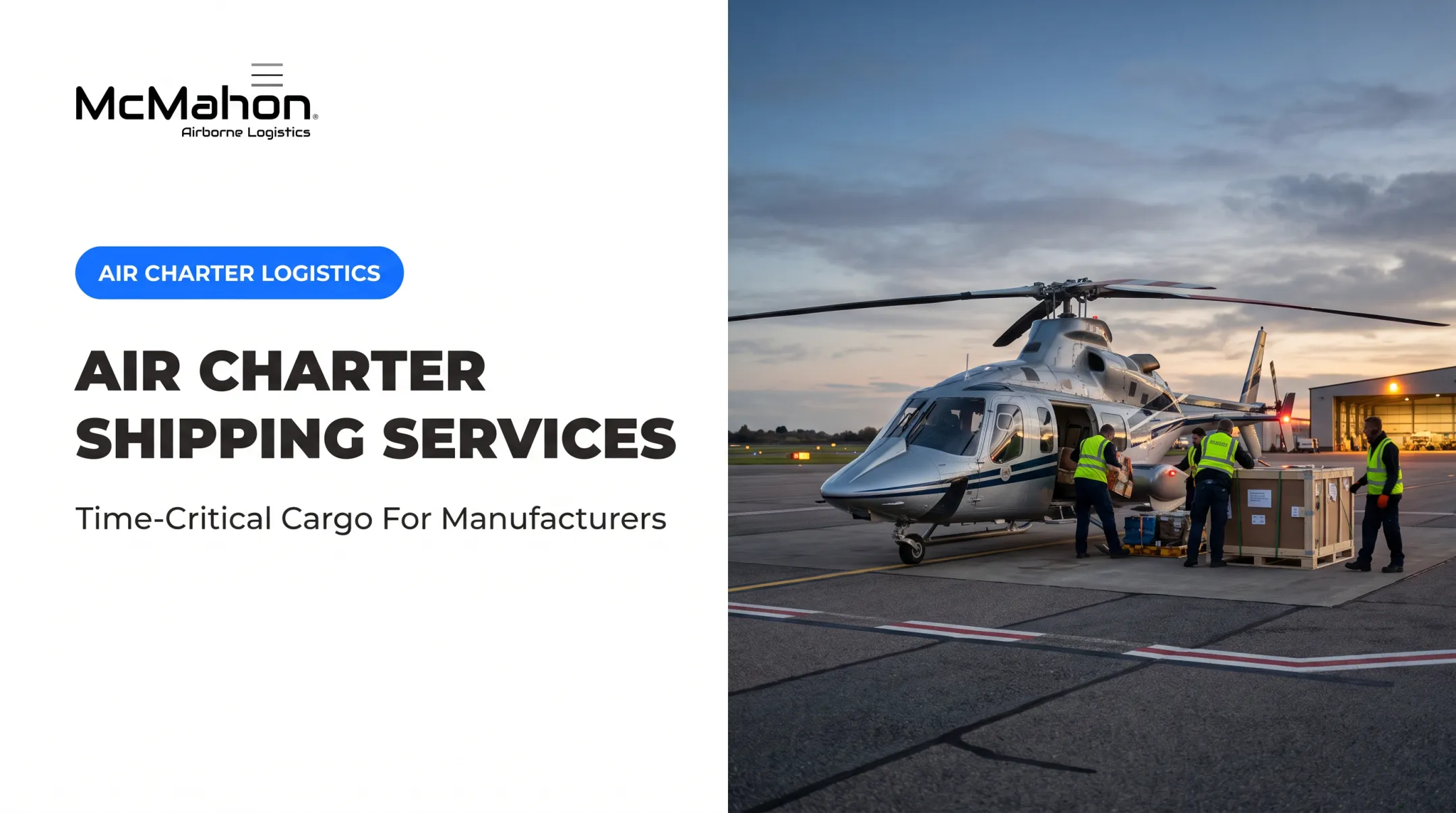
McMahon Airborne Logistics runs a dedicated fleet of twin-engine Bell 430 helicopters that can land at a facility directly, with no runway needed in most cases. Airport size only becomes a factor if fuel or ground-handling services are required at the destination.

That fills a gap that standard fixed-wing charter can't: getting cargo from plant to plant without routing through an airport at all.
Use Cases of Air Cargo Charter
Charter earns its cost when downtime, safety, or deadline risk outweighs the premium. Common triggers:
- AOG (aircraft-on-ground) parts that keep an aircraft grounded
- Factory-halting equipment failures where a single part stops the line
- Emergency shipments where a scheduled flight's timing won't work
Industries leaning on charter most heavily: automotive, aerospace, and energy, all sectors running just-in-time supply chains with little tolerance for delay.
The math is straightforward once you have real numbers. If an hour of downtime costs your plant $2.3 million (the Siemens automotive benchmark), a charter costing a few thousand dollars to save six or eight hours isn't a hard call. Your own downtime cost and charter quote set the break-even point.
That same urgency defines the response window. McMahon's Emergency Parts Delivery service calls it the "Red Zone": generally zero to eight hours from failure to delivery. Some campaigns still justify charter over days or months when a supplier falls behind schedule.

What Is Scheduled Air Freight?
Scheduled air freight means booking space on fixed-route commercial or freighter flights alongside cargo from other shippers. Airlines set the departure times, the routes, and the capacity. You reserve a slot within it.
This model works well for cost-conscious, routine shipping where the timeline has slack built in.
Core benefits:
- Lower cost per kilo than charter, especially at volume
- Predictable timetables you can plan inventory cycles around
- Established hub infrastructure with mature handling processes
Limitations to know:
- Fixed departure windows mean no flexibility if your timing shifts
- Capacity gets tight during peak season
- Restricted to major airports, which can mean added ground transport on both ends
June 2026 data from IATA shows North American cargo demand up 13.1% year over year, outpacing capacity growth—scheduled space can disappear when you need it most.
Use Cases of Scheduled Air Freight
Scheduled freight fits shipments where "on time" has some cushion:
- Regular inventory restocking on a set cadence
- Non-urgent B2B shipments between known partners
- E-commerce replenishment tied to a predictable schedule
Retail, consumer goods, and general manufacturing with planned inventory cycles rely on this model because the cost savings compound over volume.
Standard air freight on a typical route takes roughly 8–10 days in transit, with express options shaving off 2–3 days, per Freightos' route data. That timeline works fine when you're restocking shelves—not when a production line is already stopped.
Air Cargo Charter vs Scheduled Air Freight: What's Better?
There's no universal winner. The right choice depends on four questions:
- How urgent is this shipment? Hours matter, or days are fine?
- What's the cargo's size and value? Oversized or high-value freight often needs dedicated handling anyway.
- Can scheduled carriers even reach the destination? Remote plants and facilities without nearby major airports may rule scheduled freight out entirely.
- What does delay actually cost you? Compare that number to the charter premium.
- Choose charter when timing, security, or airport access is non-negotiable.
- Choose scheduled when the shipment is routine and budget is the priority.
Most businesses don't pick one mode forever. The smarter approach is hybrid: scheduled freight for planned, recurring shipments, and a charter provider on standby for emergencies.
Providers that handle both air and ground logistics, like McMahon Airborne Logistics' turnkey door-to-door coordination, simplify this. You get one quote for the full route instead of separate calls to five vendors.
Real-World Example: When Charter Made the Difference
Picture a Midwest automotive supplier running a just-in-time line. A critical stamping die cracks mid-shift. The replacement sits at a sister facility 300 miles away. No commercial flight connects the two locations directly, and the nearest scheduled freight option would add a full day of ground transport on each end.
With production already halted and the plant burning through downtime costs, waiting on scheduled freight isn't viable. The team calls a charter provider instead.
Because the part is small enough for helicopter transport and there's a clear landing area at both facilities, no airport is needed at all. Within 10-15 minutes of authorization during business hours, a helicopter can be airborne: McMahon's typical launch window. The 600-mile effective coverage radius easily covers the 300-mile hop.

Result:
- A 24+ hour scheduled freight and ground chain compresses into same-day delivery
- Against downtime that can run into the millions per hour at scale, the charter fee is a rounding error
Takeaway: when timing isn't flexible, charter delivers timing certainty scheduled freight can't match.
For time-critical shipments like this, McMahon Airborne Logistics provides 24/7 charter and ground coordination quotes at 1-800-752-8590.
Frequently Asked Questions
What is the difference between a charter and commercial flight?
A charter flight is dedicated to one shipper's cargo, with airports and timing negotiated directly. A commercial (scheduled) flight carries multiple shippers' freight on a fixed route and timetable set by the airline.
How much does an air charter cost?
Costs vary widely based on aircraft type, distance, and urgency. There's no fixed rate. Contact a provider for a quote based on your specific shipment.
How much does air freight cost?
Scheduled freight is typically priced per kilogram, with rates around $3/kg on standard routes depending on distance, season, and cargo type. It's generally cheaper than charter for routine shipments.
What does "air freight" mean?
Air freight simply refers to cargo transported by aircraft. It covers both scheduled commercial flights and dedicated charter service. The term itself doesn't specify which method.
What are the two main types of air cargo?
General cargo covers standard goods needing no special handling. Special cargo includes hazardous materials, perishables, live animals, and oversized items requiring specific packaging, labeling, and handling procedures.
What is not allowed in air cargo?
Prohibited items include undeclared hazardous materials, forbidden explosives, and anything violating FAA or PHMSA regulations, including certain unstable chemicals and pressurized devices. Always verify specifics with your carrier before shipping.